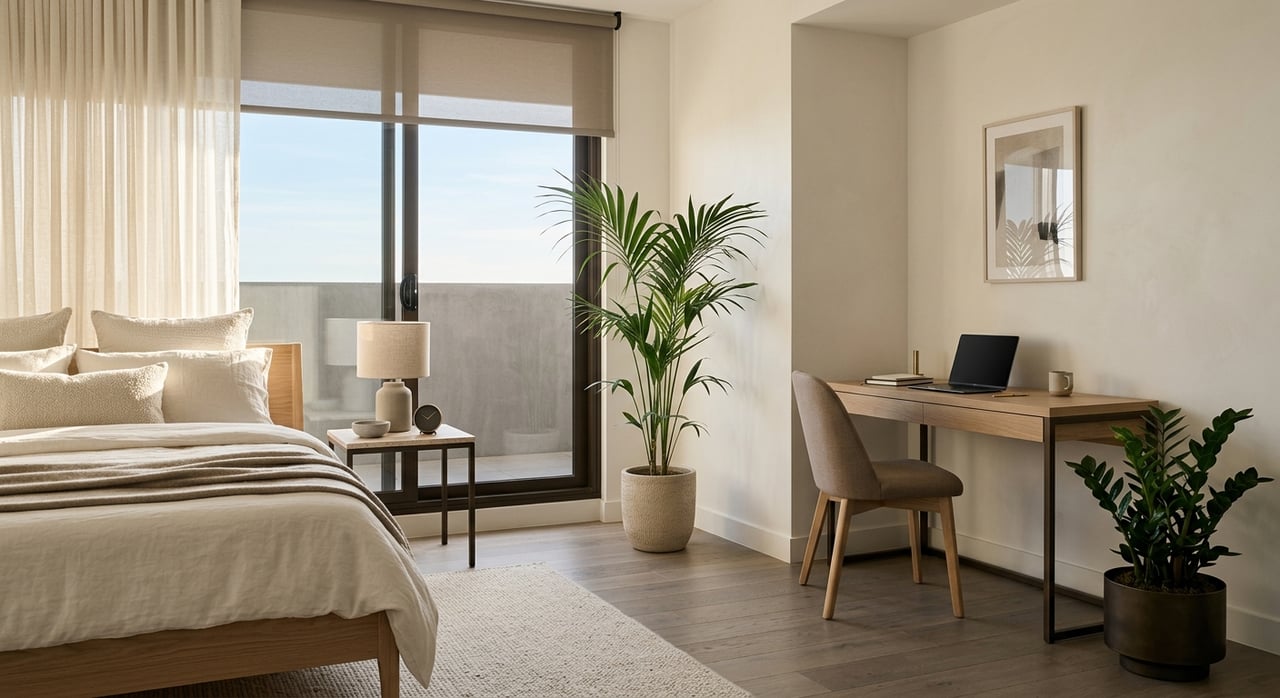
How To Evaluate A San Diego Condo As A Furnished Rental
Are you eyeing a San Diego condo as a furnished rental? Before you start pricing furniture or estimating nightly rates, you need to answer one critical question: How long will each stay be? In San Diego, the rules, taxes, and even the condo’s viability can change sharply at the 30-day mark. If you want to buy smart and avoid expensive surprises, this guide will help you evaluate the legal path, HOA fit, location, and income potential with a clear framework. Let’s dive in.
In San Diego, a furnished condo does not fall under one simple rental category. The first step is to decide whether you are evaluating a 30+ day furnished lease or a stay under 30 days.
That distinction matters because short-term residential occupancy rules apply to stays of less than one month. A longer furnished lease usually avoids the short-term occupancy and transient occupancy tax layer, but it still requires you to review HOA rules and may still trigger rental unit business tax requirements.
If your plan is flexible, do not assume you can switch between short stays and month-to-month furnished leasing later. The best condo for one model may be a poor fit for the other.
If you plan to rent the condo for less than 30 days at a time, San Diego requires both a Short-Term Residential Occupancy license and a transient occupancy registration certificate. The city also states that rental unit business tax applies when a property is rented out or held out for rent for more than 6 days in a calendar year.
San Diego’s STRO program uses different license tiers. Tier 1 covers part-time use for 20 days or less per year. Tier 2 applies to home sharing with the host onsite and absent for no more than 90 days per year. Tier 3 covers whole-home use outside Mission Beach, while Tier 4 is for whole-home use in Mission Beach.
Tier 3 and Tier 4 carry extra operating pressure. The city requires at least 90 days of annual utilization to keep those licenses, quarterly reporting is required, and licenses are not transferable.
Fees should also be part of your underwriting. As of March 1, 2025, the city lists Tier 1 application and license fees at $33 and $193, Tier 2 at $33 and $284, Tier 3 at $41 and $1,129, and Tier 4 at $41 and $1,129. These licenses expire after two years and the fees are non-refundable.
Effective May 1, 2025, San Diego’s transient occupancy tax is 11.75%, 12.75%, or 13.75% depending on the tax zone. For a typical condo, this tax is usually the main lodging tax item to budget for.
The Tourism Marketing District assessment generally applies only to lodging businesses with 70 or more rooms. That means most condo investors are focused on TOT, not TMD.
If you are evaluating a condo in Mission Beach, the short-term path is more restrictive. Whole-home STRO use there is capped at 30% of the community planning area’s housing units.
The city reported zero remaining Tier 4 licenses as of July 2, 2026. If Mission Beach is your target, you need to treat license availability as a major screening item, not a minor detail.
A condo can look perfect on paper and still fail as a furnished rental because of the HOA. That is why condo review should happen early, before you get attached to the finishes, view, or projected income.
California Civil Code 4741 allows a common-interest development to prohibit transient or short-term rentals of 30 days or less. So even if city rules allow short stays, the HOA may still block them.
The same code section also limits how restrictive an HOA can be on rentals more broadly. For example, rental caps cannot be set below 25% of the separate interests. Still, that does not mean every building is friendly to furnished rental activity.
Do not rely on a one-page HOA summary. Ask for the full due diligence package, including:
This matters because older restrictions and amendment history can still affect what you can do. Civil Code 4740 makes it important to check not just the current rules, but when restrictions were adopted and how they apply.
If your plan is to live in the condo and rent out part of it for stays longer than 30 days, California Civil Code 4739 offers protection for owner-occupied partial rentals. But that does not override HOA conduct rules such as parking, guest access, or common-area use.
In other words, legal use and practical use are not always the same. A condo with limited parking or strict guest procedures may be harder to operate smoothly, even if the rental itself is allowed.
If the host is not the owner, San Diego requires a right-to-occupy document showing legal authority to sublease for less than a month. The city also requires a business tax certificate and annual business tax.
This is especially important if you are thinking about using a tenant, corporate operator, or manager structure. You want to confirm the operating model matches city requirements before you close.
A furnished rental succeeds or struggles partly because of the building around it. In condos, the shared environment can shape guest experience, reviews, turnover friction, and complaint risk.
San Diego’s STRO complaint framework makes this especially important. The city requires local contact information to be posted, the local contact should respond within one hour, and issues like noise and trash are reportable.
That means buildings with thin walls, limited parking, difficult entry systems, or constant friction in shared spaces may create more operational risk than the purchase price suggests. A sleek condo in the wrong building can become an exhausting rental.
The strongest condo candidates usually include:
These features help the condo compete with hotel-like inventory and reduce turnover headaches. They also make month-to-month furnished leasing more appealing for corporate or temporary residents.
San Diego has strong travel demand, but that does not mean every address performs the same way. You want to evaluate the specific condo, the immediate surroundings, and the type of guest or tenant the location naturally attracts.
The San Diego Tourism Authority reports that the county had 32.4 million visitors in 2025, including 17.7 million overnight visitors. Visitor spending reached $14.4 billion, the region hosted 62 primary conventions and trade shows, and hotel occupancy was 72.2%.
Those numbers show that furnished rentals are competing in a large and active visitor market. They also show why design, convenience, and location details matter when a condo is competing against hotels and other temporary lodging options.
AirDNA’s July 2026 snapshot for San Diego shows 15,964 active listings, 61% average occupancy, a $336 average daily rate, $38.6K average annual revenue, and a 75 out of 100 market score. But AirDNA also notes that occupancy rose year over year while revenue and ADR declined.
That is a useful reminder to underwrite conservatively. Do not build your numbers around peak summer performance or assume citywide averages will match your exact condo.
AirDNA also recommends narrowing estimates to the neighborhood and specific address. In practical terms, urban-core and coastal-adjacent condos often have stronger visitor-driven or corporate-stay appeal than inland buildings with weaker walkability or tougher parking.
San Diego’s accommodation mix supports compact units more than many buyers expect. The Tourism Authority reports 16,713 homes available on Airbnb and Vrbo countywide, and 7,079 of those were studio or one-bedroom hotel-comparable units.
That suggests a smaller, well-designed condo can still be a meaningful player in the furnished rental market. The key is not size alone. The key is whether the unit feels easy, efficient, and well-positioned for the stay type you are targeting.
A smart purchase decision comes from modeling both revenue and friction. Furnished rentals often look attractive at the top line, but the added costs can narrow the real premium quickly.
For a 30+ day furnished lease, local rent is your starting point. As of July 2026, Zumper places the San Diego average at $2,779 per month, while Zillow shows about $3,038 per month as of June 30, 2026.
Because those platforms measure rent differently, it is safer to treat them as a range, not a single comp. Then adjust for your unit’s design, parking, building quality, and location.
For short-term furnished use, citywide averages can help you build a first-pass model. AirDNA’s 61% occupancy and $336 ADR are reasonable starting points for San Diego.
Still, a first-time operator or an HOA-constrained condo should generally be underwritten below the market average unless the unit has a clear edge. That could include dedicated parking, exceptional walkability, or a standout view.
Your budget should include more than a sofa and a bed. At a minimum, account for:
If the strategy is short-term, also add San Diego’s non-refundable application and license fees plus the two-year renewal cycle. These items can materially change your return.
One of the clearest ways to evaluate a San Diego condo is to ask whether the extra gross income from furnishing and short-term use clearly exceeds the extra costs and friction. That includes taxes, licensing, HOA limitations, cleaning, wear and tear, and replacement costs.
If the premium is thin, the better move may be a standard long-term rental or an owner-occupancy plan. Not every attractive condo is a strong furnished rental, and forcing the wrong strategy can reduce both income and flexibility.
The strongest candidate is usually the condo whose legal use matches your intended stay length, whose HOA rules are compatible, whose building can handle guest traffic, and whose location and layout can outperform the average rather than just blend into it.
If you want help evaluating a downtown condo, coastal unit, or design-forward investment property in San Diego, Laura Valente can help you assess the purchase, the layout potential, and the best path from acquisition to rental performance.

We pride ourselves in providing personalized solutions that bring our clients closer to their dream properties and enhance their long-term wealth. Contact us today to find out how we can be of assistance to you!